If you’ve been arrested for driving under the influence (DUI) in California, you’re likely facing a confusing legal process filled with unfamiliar terms and serious consequences. One term you may encounter is Ignition Interlock Device (IID), a tool increasingly used across the state to monitor and prevent drunk driving. A skilled criminal defense lawyer in San Diego, California, can help you understand what an IID is, how it works, and whether it may be required in your case.
For those dealing with a DUI arrest in Southern California, working with Attorney Anna R. Yum can make a significant difference in handling the challenges of IID requirements and court proceedings. Experienced San Diego DUI attorney Anna R. Yum has helped countless clients throughout the county understand their obligations under California’s strict DUI laws and work toward the best possible outcome.
For personalized legal guidance, contact the Law Offices of Anna R. Yum at (619) 233-4433, an experienced firm dedicated to defending your rights and helping you move forward.
What Is an Ignition Interlock Device?
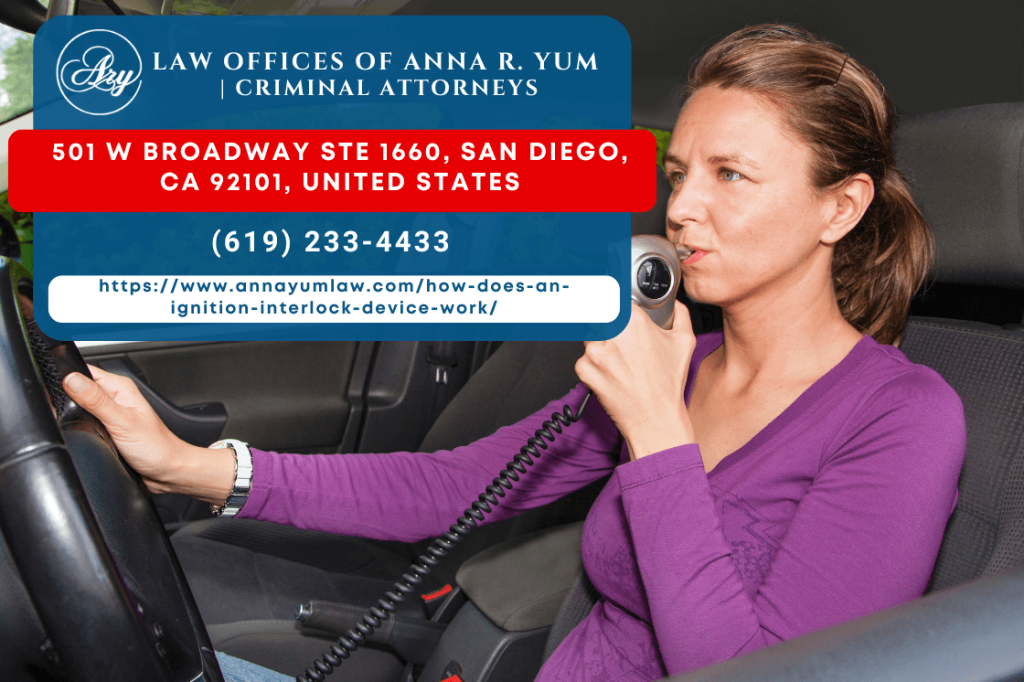
An Ignition Interlock Device is essentially a portable breathalyzer installed directly into your vehicle. Think of it as a built-in safety mechanism that prevents your car from starting if you’ve been drinking. Before you can start your vehicle, you must blow into the device, which measures your blood alcohol content. If the device detects alcohol above a preset limit (typically around 0.02% BAC), your vehicle won’t start.
The IID is designed to be tamper-resistant and must be professionally installed by state-certified technicians. It’s connected to your vehicle’s ignition system, creating a direct link between your breath sample and your ability to operate the vehicle. This technology has become an increasingly common tool in California’s efforts to reduce drunk driving and keep roads safer.
When Are You Required to Get an IID?
There are two primary situations where you might be required to install an Ignition Interlock Device in California.
- To Get a Restricted License After a DUI Arrest: If the California Department of Motor Vehicles has suspended your license and you still need to drive for work, school, or family obligations, you may be eligible for a restricted license. This type of license usually requires you to install an IID in your car. Many drivers apply for restricted licenses through local DMV offices in Clairemont, El Cajon, Chula Vista, or Oceanside to maintain their ability to commute to work while their DUI case is pending.
- As a Condition of a DUI Conviction: If you’re convicted of DUI in one of the region’s courthouses, such as the downtown courthouse on Broadway, the South Bay courthouse in Chula Vista, the East County facility in El Cajon, or the North County Regional Center in Vista, the judge may order you to install an IID as part of your sentence. This requirement serves both as a punishment and a preventive tool to ensure sober driving during your probation period.
Local law enforcement agencies throughout the region, including police departments in Oceanside, Carlsbad, Escondido, National City, La Mesa, and other municipalities, work closely with the courts and the District Attorney’s office to monitor IID compliance. This coordinated approach means that violations are quickly detected and reported to the appropriate authorities.
DUI Lawyer in San Diego – Law Offices of Anna R. Yum

How Long Will You Need an IID?
The duration of your IID requirement depends heavily on several factors, primarily the number of prior DUI convictions you have and the specific circumstances of your current offense. California law provides a graduated scale of penalties that increases with each subsequent offense.
For a first-time DUI offense where your blood alcohol level was 0.15% or greater at the time of driving, the court can impose an IID requirement for up to six months. This enhanced penalty for higher BAC levels reflects California’s concern about particularly dangerous levels of intoxication. Even though it’s your first offense, the elevated blood alcohol content triggers this extended IID period.
If you have a prior DUI conviction within the last ten years, your current case would be considered a second DUI offense. In this scenario, the IID requirement increases significantly, potentially extending up to one year rather than the six months applicable to first offenders. This doubling of the requirement period underscores how seriously California treats repeat offenders.
For those with multiple prior DUI convictions within the last ten years, the length of time you’re required to maintain an IID in your vehicle continues to increase. The exact duration will depend on your specific circumstances and the court’s determination, but you can expect substantially longer periods as your number of priors grows.
How Does the Device Actually Work?
Understanding the day-to-day operation of an Ignition Interlock Device is important for anyone who will be required to use one. The process begins each time you want to start your vehicle. Before turning the ignition, you must provide a breath sample by blowing into the device’s mouthpiece. The IID analyzes your breath for alcohol content and determines whether you’re within the acceptable range to operate the vehicle.
If the device detects no alcohol or an amount below the preset threshold, it will allow your vehicle to start normally. However, if alcohol is detected above the acceptable limit, the ignition will remain locked, and you won’t be able to start the car. The device logs this failed attempt, which becomes part of the record that’s regularly reviewed by the California DMV and, in local cases, potentially by your assigned probation officer at one of the probation offices located throughout the region, including facilities in downtown, Chula Vista, Vista, and El Cajon.
What many people don’t realize is that the IID doesn’t just test you once at the beginning of your trip. As you continue driving, the device may prompt you to provide additional breath samples in what are called “rolling retests.” When this happens, you’ll need to safely pull over and blow into the breathalyzer again. These rolling retests serve an important safety function by ensuring that you haven’t consumed alcohol after starting the vehicle or that someone else didn’t provide the initial breath sample on your behalf.
The frequency of these rolling retests varies, but they typically occur at random intervals to prevent drivers from predicting when they’ll be required to test. This randomness is intentional and designed to maintain compliance throughout the entire driving period, not just at the beginning of a trip.
What Happens If You Fail a Test?
One of the most common concerns people have about IIDs is what happens if you fail a breath test, particularly a rolling retest while you’re already on the road. It’s important to know that the device is designed with safety in mind. If you fail a rolling retest while driving, the car will not suddenly shut off or stop in the middle of the road, which would create an obvious safety hazard.
Instead, the device will typically trigger your vehicle’s horn to honk and lights to flash, alerting you and others that a violation has occurred. This continues until you turn off the vehicle. The failed test is immediately logged in the device’s memory, creating a permanent record of the violation. These logs are regularly downloaded during your mandatory service appointments and reported to the monitoring authority, which in local cases typically includes the court where you were sentenced, the California DMV, and possibly your probation officer.
Repeated failures can lead to:
- Extended IID usage
- Additional court penalties
- Probation violations
- Potential additional charges filed by the District Attorney’s office
It’s crucial to understand that these devices are highly sensitive and can detect even small amounts of alcohol, so complete abstinence while you have an IID requirement is the only safe approach.
The Financial Cost of an IID
Beyond the legal and practical implications, there’s also a significant financial aspect to consider when it comes to Ignition Interlock Devices. These costs can add up quickly and should be factored into your overall budget while dealing with a DUI case.
- Initial Installation Costs: The IID must be installed by a certified professional technician from a California-approved provider. Installation typically costs between $100 and $150, depending on your location and the specific provider you choose. Throughout the region, from Oceanside and Carlsbad in the north to Chula Vista and Imperial Beach in the south, and from coastal communities like La Jolla and Del Mar to inland areas like Santee, Poway, and Ramona, several state-certified providers offer installation services at various locations. The technician will install the device and provide you with training on how to use it properly.
- Regular Maintenance and Calibration: The IID requires maintenance appointments typically every 60 days to ensure it’s working correctly. Each maintenance appointment comes with its own fee, which varies by provider. During these visits, the technician will download the data logs from your device, perform any necessary calibration or maintenance, and ensure everything is functioning properly. These maintenance visits are mandatory, and failing to attend them on schedule can result in violations reported to the courts and penalties.
- Ongoing Daily or Monthly Rental Fees: There’s a daily or monthly rental fee for having the device in your vehicle. This ongoing cost can range from several dollars per day to monthly fees that can exceed $100, depending on the provider and the specific terms of your requirement. When you multiply these daily costs by the number of months you’re required to have the device, whether that’s six months, a year, or longer, the total financial burden becomes substantial.
For individuals already facing the numerous costs associated with a DUI, including fines, increased insurance rates, legal fees, and potentially lost wages, the IID expenses can create significant financial strain. However, it’s important to remember that in many cases, the IID is what allows you to maintain some driving privileges rather than facing a complete license suspension, which could impact your ability to work and earn income.
| Cost Category | What It Covers | Cost Range / Frequency (from article) |
|---|---|---|
| Initial Installation Costs | Installed by a certified professional technician from a California-approved provider; includes training on proper use | $100–$150 (typically) |
| Regular Maintenance and Calibration | Mandatory appointments where the technician downloads data logs, calibrates/maintains the device, and confirms it’s functioning properly; missing visits can lead to court-reported violations and penalties | Typically every 60 days; fee varies by provider |
| Ongoing Daily or Monthly Rental Fees | Ongoing rental cost for keeping the device in the vehicle; total cost increases depending on how long the IID is required (e.g., six months, a year, or longer) | Several dollars per day OR monthly fees that can exceed $100 |
Take Control of Your DUI Case Today
Dealing with a DUI charge can be overwhelming, but understanding the role of an Ignition Interlock Device is an important step toward managing the legal process and protecting your future. While the IID requirement may seem like a burden, it can also be an opportunity to retain limited driving privileges and demonstrate your commitment to safe driving.
If you have questions about IID requirements or need help navigating your DUI case, don’t face it alone. Contact the Law Offices of Anna R. Yum at (619) 233-4433 to speak with a trusted San Diego DUI attorney. With experience, compassion, and a deep knowledge of California DUI laws and local court procedures throughout the region, Attorney Anna Yum can provide the guidance you need to move forward with confidence.